GRAP Basics
2022: Even before Ukraine, there was a widespread consensus that our challenges need to be faced with a new clarity, urgency and collaboration – clearly, the current rate of progress is too slow. There appears to be a very wide gap between policies, plans and implementation. This paper takes a quick look at the current planning environment, and how it could change under GRAP.
What is it?
The GRAP process is simple. The basic steps are: identify the main issues; identify the parties involved; identify the main (actual, working) objectives of each party. Make it all transparent and accessible. Results: engagement, focus, alignment. Objective: A collective approach, and a sense of shared accountability. These are the basic ingredients needed to make GRAP, or any other system, work.
Some of today’s top concerns include: Climate Change; Biodiversity; Social Justice and human welfare. This author focuses on Biodiversity and Environment, and specifically, Agriculture, for reasons that will become clear as we go. Further analysis of the situation today:
- The planning environment has changed, especially in government. To a large extent the public sector has backed away from a collective or systemic approach in the last 20+ years. There is a marked reduction in effective planning and goal setting in general, both inter and intra-agency. The public sector has become more private and segregated, in step with a national culture that is more hyper-individual and divisive. This isolationism has been re-enforced by software, by top-down management, and in some cases by law and policy. Where clear goals are set, they may refer more to in-house metrics than to real-world effects.
- A method synonomous with GRAP was branded in the late 1990’s and adopted by companies such as Google, Amazon, Microsoft, and Uber. Needless to say, it has proven very successful, and come in to widespread recognition. The method is termed OKR, for Objectives and Key Results.
- OKR has been used by public agencies, such as the State of Oregon, to coordinate goals in-house. But it may not be widely in use between such agencies, or sector-wide.
- The financial industry has always achieved alignment around certain objectives, such as growth, profit and GDP. Today, it is showing rapid development around a wider set of shared objectives, such as ‘ESG’, or Environment/Social/Governance. The products are popular, but methods, metrics, and accuracy are variable and inconsistent. Still, the industry is taking an impressive role in these efforts.
- Global initiatives, notably the Paris Climate Talks, or the IPCC, or Convention on Biodiversity, or the IUCN are rapidly developing collective goals. Once again, methods and metrics may be some years behind the stated goals and timeframes (see Granthum Fund reports).
- In agriculture, since the O’Bama administration, the USDA has been actively pursuing a systems approach that encourages previously estranged Departments to collaborate. This effort was accelerated under the Trump administration, with the wider intention of downsizing, streamlining, and alignment. The effectiveness of this process to date is hard to estimate, but the continued resolve despite political reversals is impressive.
- The Biden Administration has expressed an ‘All Government’ approach to problem solving, including climate change, biodiversity, and social justice. Partnerships and collaboration are presented as a core part of the overall strategy.
- There are many programs, or perhaps better termed as social movements, that are now playing important roles. For biodiversity, there is a mobilization of ‘Citizen Scientists’, with groups such as iNaturalist, that coordinates the efforts of thousands of volunteers around the world. Volunteers report instances of ecological significance via common software tools, and are branching out in to other functions. Such citizen participation tools are also prevalent in China and elsewhere.
- Major firms facilitate and coordinate important social programs. An example is Google Outreach, that provides a wide range of information services to cities and other entities, at no charge. These services help to identify, inform, and coordinate a wide range of objectives.
- In summary, collective goals and strategies are under rapid development, and the tools are increasingly available to implement them. The problem is, that the status quo is still the dominant force – change is far too slow. A strategy is needed that will accelerate and mobilize the needed changes, in accordance with the rapid pace of environmental and social degradation. How will this come about?
A New Strategy: from Movements to Mobilization
Scientists indicate that we may have only several year’s time to turn around global warming and species extinctions. We may already be well past the ‘tipping points’ for many of the resources that are critical to humans and the planet as a whole. Time may already have run out for most species, and is expiring quickly for the remainder. In that context, movements are not enough, and we must think in terms of mobilization, as in pandemics or global crises.
We are in a global crisis now, to save a global eco-system. Consider the following comparison: In 1942, the Axis powers were a serious threat to political stability, and the Allies went to a war footing to meet that threat. Imagine, please, if we had responded only via popular movements, such as the United Way Anti-Facist League? Or via the Washington two-party gridlock? That is in some sense where we are today with climate change and biodiversity. Instead of a thousand fragmented efforts, we need an ‘All-in’ approach. Having lost so many of the battles, should we continue with the same methods?
The All-in approach (GRAP, or OKR) will not come from inside government, or from inside corporations or even from whole sectors. Left to their own devices, these entities will continue in the comfort and stability of the status quo. The American system has, by design, never functioned well without widespread public participation and oversite. And our wars were never successful without full public support.
Who are the representatives today who can come together to initiate an all-systems-wide alignment around a wide set of objectives? If we look closely, the answer is simple: the ones who are already doing it. If we can identify them, and connect and empower them, and then join the effort as a citizenry, then we can accomplish nearly any reasonable set of goals.
So who are these players and coalitions? They are not hard to find. Following is a very small sample of some influential parties, only by way of illustration: Additional discussion will follow this summary.
Re-alignment Examples
Non Profits and NGO’s – There are hundreds of entities in any given field that can and do play a major role in change, either alone or collectively. These parties generally work outside the ‘establishment’ and rely on direct, sustained donations from both large and small donors. By their nature, these players need to be transparent and communicative, showing real, ongoing successes to contributors in order to raise support. Increasingly, many are stressing the current urgency and are espousing partnership and collaboration as the most critical components of current strategy. Some major players in the environmental field are Nature Conservancy, Sierra Club, World Wildlife Federation, Environmental Defense Fund – and dozens of others. Examples of ones that specialize in collaboration include:
- United Way – Global Results Framework
- Millenium Alliance
- Florida Springs Council – 50 members;
- Climate Change Collaborative
- NSAC – National Sustainable Agriculture Coalition
- SARE – Sustainable Agriculture Research and Education
- TNC, EDF, IATP, Sierra Club, Audubon, and dozens of others organizations
IUCN – International Union for the Conservation of Nature – STAR Metric, 1400 organizations
International Coordination – Paris Climate Talks; IPCC; Center for Biodiversity; World Bank;
Global Investment –
- Environment/Social/Governance (ESG) – $86 T in assets affected?
- The Stock Exchanges
- Brown Advisory
- Granthum Fund – establishing metrics and methods.
- Increasingly, the whole private sector
Google Outreach – OKR since 1999; and many other software tools (Facebook, Amazon….)
States – Oregon, and OKR; Vermont, and RCPP; Pennsylvania, and PNDI; And many others.
Regions – Chesapeake Bay; Mississippi; Lake Erie; Pacific Northwest; Arctic Preserves
Federal Agencies –
- USDA – RCPP – Regional Conservation Planning Partnerships
- USDA Farm Production Business Center – FPAC
- The Government Performance and Results Modernization Act of 2010 – GRPA
- USDA Rural Development – Strategic Plan 2022
Citizens Science, and iNaturalist –
How many of the above organizations would participate in a universal collaborative process like GRAP? Which ones would help to initiate it?
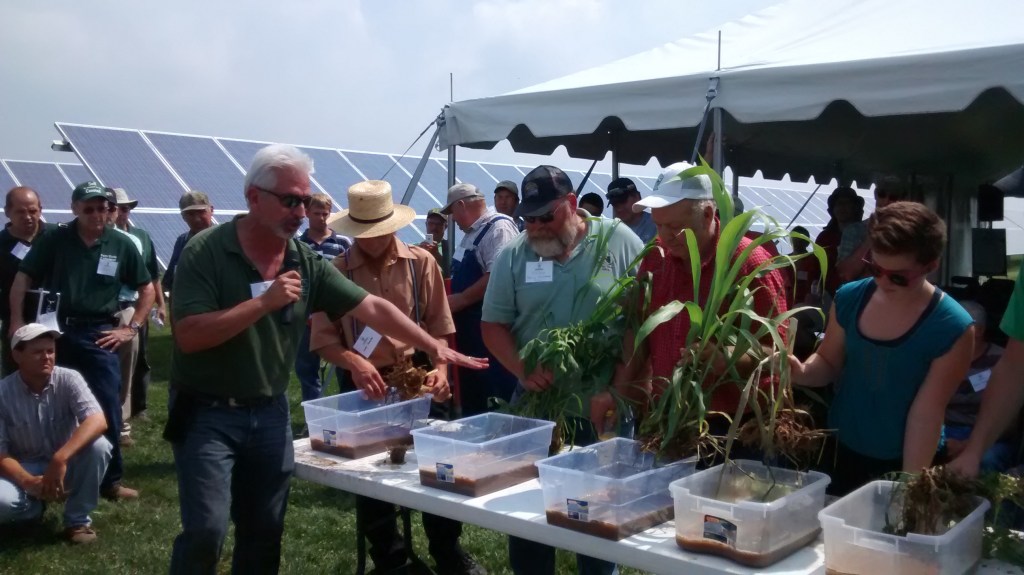
Ray Archuleta at a PA farm clinic 2016
Ch3—GRAP_basics.doc
 Panicaea